I have released flink-datastream-protobuf 1.0.0, a library for using Protocol Buffers messages as native Apache Flink DataStream types and managed-state values. It is the first release published to Maven Central. It provides explicit type information, configuration-based type registration, and descriptor-based checks when restoring state after a supported schema change.
My performance goal was to match Chill and improve on it where native integration could avoid work. After several rounds of optimization, the native serializer reached that goal for ordinary serialization and deserialization on the Protobuf 4 runtime in the release-candidate measurements: it took 0.34–0.88 times Chill's serialization time and 0.54–0.88 times its deserialization time across all five workloads. Those are serializer measurements on one machine configuration; other representations win some comparisons, and none of these numbers measures a complete Flink job.
Why I built it
I build, operate, and maintain Flink pipelines on Google Cloud that carry Protobuf messages between operators. Protobuf is a frequent part of that work: many Cloud APIs offer gRPC interfaces, and BigQuery's Storage Write API accepts Protobuf records for gRPC streaming. For these pipelines, working with Protobuf objects throughout a Flink job is a practical requirement.
I have also contributed to Flink's Protobuf format through Apache Flink #21613. That change fixed code-generation failures for imported message types such as google.protobuf.Timestamp, with tests for conversion in both directions. That Table/SQL format converts connector data into Flink's table representation. For DataStream jobs that pass generated Protobuf objects between operators and keep them in state, I wanted a native integration I could maintain and improve over time.
A source's DeserializationSchema turns incoming bytes into Java objects; Flink then needs a separate TypeSerializer as those objects cross operator boundaries or enter managed state. When Flink cannot select a dedicated serializer for a type, it can treat the object as generic and fall back to Kryo. Its documentation shows how to register Twitter Chill's Protobuf adapter on that path. Encoding Protobuf at a connector boundary does not select this internal serializer.
Chill's long pause in releases and development was the main reason I wanted to replace that dependency. As of November 1, 2026, its latest GitHub release is 0.10.0, published on June 4, 2021. The latest commit on its default branch, develop, is a dependency update from March 19, 2023. For pipelines I expect to maintain through future Flink and Protobuf upgrades, relying on a library with that maintenance history is a risk I do not want to keep carrying.
The dependency versions show how far the components have drifted apart:
| Component | Kryo version in its build |
|---|---|
| Chill 0.7.6 | 2.21 |
Chill develop at its latest commit | 4.0.2 |
| Flink 1.20.5 | 2.24.0, with Chill 0.7.6 |
| Flink 2.3.0 | 5.6.2 |
The Flink 2.3 documentation still illustrates Protobuf registration with chill-protobuf:0.7.6 and protobuf-java:3.7.0. That puts a Chill adapter built against Kryo 2 in the instructions for a Kryo 5 runtime. My initial experiment transported a message with Chill 0.7.6 on Flink 2.3.0's Kryo 5.6.2, using Protobuf 3.25.8 rather than the documented 3.7.0. Later checks exercised Chill 0.10.0 on the supported Flink 2.x minors. Those results establish that the tested paths work today; they leave the question of who will maintain the integration as its dependencies evolve.
If I was going to take responsibility for that maintenance, I preferred to build the Protobuf integration I wanted directly against Flink's native type APIs instead of maintaining a Chill fork. A replacement Kryo adapter would still leave messages as generic types from Flink's perspective. A native TypeInformation and TypeSerializer let me use generated messages with pipeline.generic-types: false, control allocation and copying, and define the state-restore policy in the library itself.
That restore policy matters for the stateful jobs I maintain. Being able to parse old Protobuf bytes alone does not tell me whether a new message schema can restore a savepoint: Flink must accept the serializer metadata, and the application must handle the restored values correctly. Flink already provides native type and serializer-snapshot integration for Avro; I wanted the equivalent foundation for Protobuf, with explicit compatibility rules and recovery tests.
What 1.0.0 provides
The application entry points are ProtobufTypeInformation and ProtobufTypeInfoFactory. The library handles full-runtime proto3 generated messages and descriptor-bound DynamicMessage values. Lite messages, proto2 payload types, and editions payload types are outside its supported scope, including when reached through a nested message. The usage guide describes these boundaries and the supported nested Flink types.
Both artifact lines use the same Maven group and artifact name:
<dependency>
    <groupId>io.github.flink-gcp</groupId>
    <artifactId>flink-datastream-protobuf</artifactId>
    <version>1.0.0</version>
</dependency>
Version 1.0.0 runs on Flink 2.2 and 2.3 with Java 17 or 21. Use 1.0.0-1.20 for Flink 1.20 LTS with Java 17. Each line's jar is built with Protobuf 4 and runs unchanged with the supported Protobuf 4.x or 3.25.x runtime and matching generated code. The release was checked with Flink 2.2.1, 2.3.0, and 1.20.5, and Protobuf/protoc 4.36.2 and 3.25.9. The application supplies Flink and protobuf-java; the library declares them as provided dependencies.
Stay on the artifact line matching the Flink runtime. Maven orders 1.0.0-1.20 after 1.0.0, so an update tool can otherwise propose the LTS artifact to a Flink 2.x application. The compatibility guide includes update-tool configuration.
Selecting the native type
The following fragment uses Event from the project's standalone example, generated from a proto3 schema with account and amount fields. The partitioning line follows the stateful example, and the quickstart provides the build configuration and complete entry points.
import org.apache.flink.api.common.typeinfo.Types;
import org.apache.flink.configuration.Configuration;
import org.apache.flink.configuration.PipelineOptions;
import org.apache.flink.streaming.api.environment.StreamExecutionEnvironment;

import io.github.flink.gcp.protobuf.ProtobufTypeInformation;
import io.github.flink.gcp.protobuf.examples.generated.Event;

Configuration config = new Configuration();
config.set(PipelineOptions.GENERIC_TYPES, false);
var env = StreamExecutionEnvironment.getExecutionEnvironment(config);

var eventType = ProtobufTypeInformation.of(Event.class);
var events = env.fromData(
        eventType,
        Event.newBuilder().setAccount("alice").setAmount(2).build(),
        Event.newBuilder().setAccount("bob").setAmount(7).build());

var updated = events
        .map(event -> event.toBuilder().setAmount(event.getAmount() + 1).build())
        .returns(eventType);

var keyed = updated.keyBy(Event::getAccount, Types.STRING);
Disabling generic types makes missing native type information fail instead of silently selecting Kryo. It does not register the Protobuf factory by itself. For configuration-based registration, apply these options when constructing the environment, before type extraction:
pipeline.generic-types: false
pipeline.serialization-config:
  - com.google.protobuf.AbstractMessage: {type: typeinfo, class: io.github.flink.gcp.protobuf.ProtobufTypeInfoFactory}
The superclass matters: Flink's factory lookup follows the superclass chain, so registering the Message interface does not cover generated message classes. Factory registration also covers message fields inside POJOs and tuple elements; it is process-global, while explicit type information avoids that registration. The registration example shows how to load the configuration.
The keyBy above extracts an account string deliberately. Messages are supported as values, not as partitioning keys or MapState user keys. Deterministic Protobuf serialization does not make message bytes canonical across builds or make generated-message hashing stable across JVMs.
Restoring state after a schema change
The serializer snapshot retains descriptors alongside the type identity and settings. At restore time, the library compares those descriptors with the new type and accepts unchanged schemas or its supported forward changes. The policy is deliberately narrower than everything Protobuf's wire format can parse:
| Change | State restore in 1.0.0 |
|---|---|
| Add a field with a fresh, unreserved number and name | Accepted |
| Remove a field and reserve its number | Accepted |
| Add an enum value with a new, unreserved name and number, preserving existing order | Accepted |
Change an existing field from int32 to int64 | Rejected |
| Remove an enum value | Rejected |
These examples assume unchanged type names and other declarations, supported snapshot formats, and nondecreasing size/depth limits; the full rules specify the remaining conditions. For generated messages, an added field returns its default when the saved payload contains no value for it. A value retained as an unknown field can instead populate the added field, so application logic must account for both cases. The recovery tests exercise checkpoint recovery and savepoint restoration with HashMap and RocksDB backends, including jobs whose application jar contains only the new generated classes.
Version 1.0.0 begins the 1.x stable API and forward-restore contract. Later 1.x releases must restore earlier 1.x state for the supported schema changes with the same artifact line, Flink minor, and Protobuf runtime and generated code. That contract does not promise downgrades or cross-Flink-minor restores. The earlier 0.x milestones were unpublished development versions, and 1.0.0 does not read their state.
What the performance comparison measures
The release-candidate run used temporary Google Compute Engine c3-standard-8 VMs with Intel Sapphire Rapids CPUs, 8 vCPUs, and 32 GB of memory. Each Protobuf profile ran on its own VM, using Flink 2.3.0, Temurin 17.0.21, G1 GC, and a fixed 1 GiB heap. The comparators were Chill 0.10.0, Kryo 5.6.2, Avro 1.11.4, and Thrift 0.25.0.
JMH 1.37 measured each cell in five independent JVM forks, with five one-second warmup iterations and five one-second measurement iterations per fork, using one benchmark thread. Native Protobuf and Chill ran in adjacent blocks with alternating order. The GC profiler recorded allocated bytes per operation, and correctness checks verified the selected serializers and round-tripped values before timing.
All representations carry the same nine logical fields, with 64 records per workload:
| Workload | Populated data |
|---|---|
| scalar | Scalar values, with empty/default structured fields |
| text | ASCII, Japanese, and accented text, plus 1 KiB of bytes |
| nested | A child record containing an integer and a Unicode string |
| collections | 16 long values and 16 string-to-long map entries |
| large | 64 KiB of bytes |
This is one schema with different populated shapes, not a minimal schema separately tuned for each format. Fixed-field representations still encode their empty/default fields. Ordinary serialize cycles through prebuilt, previously encoded messages, so Protobuf's memoized sizes can be warm. buildAndSerialize separately includes constructing fresh records from prebuilt logical values. Class initialization and descriptor discovery are outside the timed operations.
The measured source is 9e7d175. Its production source and POM are unchanged at the v1.0.0 tag, but the benchmark built a jar per Protobuf profile at Flink 2.3.0; publication builds one Protobuf 4 jar per artifact line, with a Flink 2.2.1 floor for the 2.x line. The report records a local class/resource equivalence check, not a direct measurement of the Maven Central jar. It links the retained CSV and JMH evidence for checking the results.
Native Protobuf and Chill
The figure uses native/Chill time ratios for Protobuf 4.36.2. A value of 0.5 means native took half the time for that operation. Points are paired geometric ratios; bars are per-cell 95% intervals calculated from the five log ratios. They are not a simultaneous confidence statement about all operations.
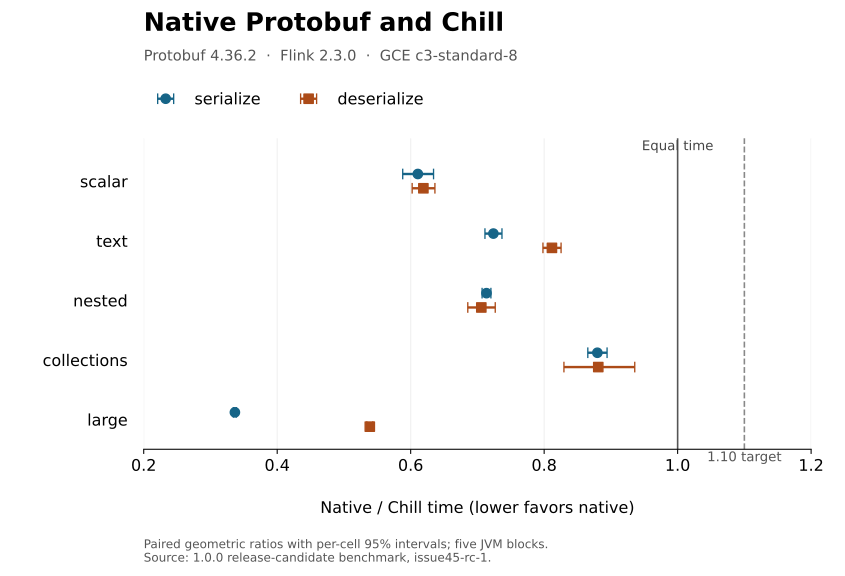
The practical target was set before measurement: an interval entirely at or below 1.10 establishes that cell's 10% tolerance. All 40 Protobuf 4 cells met it. This meets the project's original performance target on that configuration, with ordinary serialization and deserialization faster than Chill in every workload shown above: each of those ten intervals is entirely below 1.0. Protobuf 3.25.9 met it in 38 of 40 cells; text buildAndSerialize and collections serializeSameInstance crossed the threshold and remained inconclusive. No interval was wholly above the threshold. The inconclusive text result had substantial fork-to-fork variation, so a favorable point estimate alone would overstate the evidence.
For Protobuf 4, the scalar serialize ratio was 0.611 (0.588–0.634), and the large ratio was 0.337 (0.334–0.339). That corresponds to about 39% and 66% less serialization time in those cases. Collections had the smallest margin, at 0.880 (0.865–0.894). The fresh-construction measurement also favored native, but by less: buildAndSerialize ratios ranged from 0.647 for large to 0.886 for collections.
Allocation and encoded size answer different questions. The table below reports ordinary serialize on Protobuf 4; each pair is native / Chill. Allocation is the arithmetic mean of five fork scores, and encoded bytes are the mean over the corpus, including each serializer's framing.
| Workload | Allocated bytes/op, native / Chill | Encoded bytes, native / Chill |
|---|---|---|
| scalar | 149.1 / 187.6 | 23.9 / 22.9 |
| text | 1,957.1 / 3,642.0 | 1,663.8 / 1,663.8 |
| nested | 245.1 / 307.6 | 46.4 / 45.4 |
| collections | 533.1 / 1,047.3 | 498.1 / 498.1 |
| large | 4,519.3 / 65,729.4 | 65,563.9 / 65,564.9 |
Large-message serialization allocates about 4.5 KB per operation here, compared with Chill's 65.7 KB. Encoded sizes remain close because both carry Protobuf payloads, though their framing differs. Neither the allocation column nor the encoded-size column measures peak heap usage, checkpoint size, or Flink network overhead.
Copy operations need their own interpretation. Native object copy returns the immutable message reference, whereas Chill serializes and parses another value. Native stream copy transfers framed bytes through reusable storage; Flink's Kryo stream copy deserializes and serializes. Those operations can therefore differ by much more than ordinary encoding, but their ratios are not encoding speedups.
Comparing other representations
Choosing Protobuf also means choosing its wire representation and generated-object model. The following table compares ordinary serialize across the same five workloads on the Protobuf 4 VM. Times are arithmetic means of five fork scores in ns/op, not the paired geometric ratios above. These descriptive means do not carry a statistical ranking of every pair.
| Serializer | scalar | text | nested | collections | large |
|---|---|---|---|---|---|
| Native Protobuf | 54.5 | 808.1 | 88.2 | 777.3 | 3,632.8 |
| Chill Protobuf | 89.3 | 1,116.3 | 123.7 | 883.5 | 10,792.0 |
| Flink POJO | 111.4 | 1,383.0 | 133.4 | 388.6 | 2,774.5 |
| Flink Tuple | 71.9 | 1,271.3 | 98.3 | 309.9 | 2,696.8 |
| Avro Specific | 120.9 | 833.0 | 152.3 | 548.6 | 2,847.6 |
| Avro Generic | 137.6 | 851.9 | 165.9 | 587.6 | 2,892.2 |
| Chill Thrift | 1,039.7 | 1,864.9 | 1,053.0 | 2,678.0 | 13,778.6 |
| Kryo | 255.0 | 1,020.9 | 303.7 | 1,206.3 | 3,314.2 |
The POJO and Tuple lanes explicitly assign native field serializers and reject nested Kryo fallback. Avro uses its specific-record and generic-record serializers. The standalone Kryo lane uses a separate Java representation with registered root, child, and collection classes; it is not unconfigured Kryo applied to a Protobuf message. Chill Protobuf and Chill Thrift use their format adapters through Flink's generic serializer.
Native Protobuf has the lowest mean serialize time for scalar, nested, and text in this Protobuf 4 run; its text mean is about 3% below Avro Specific's. For collections, however, it takes about twice POJO's time and 2.5 times Tuple's time; both Avro lanes are faster too. Protobuf encodes each map entry as a length-delimited message and long values as varints, whereas the POJO and Tuple serializers use fixed-width longs without per-entry message lengths. Those are structural differences; this benchmark does not isolate how much each contributes. The native collections record also averages 498.1 encoded bytes, versus 420.9 for POJO and 409.2 for Tuple.
Large records give another useful boundary. Native Protobuf is much faster than Chill Protobuf, but slower than POJO, Tuple, Avro, and the standalone Kryo lane. An application already using Protobuf can benefit from the native serializer without that making Protobuf the best format for every workload.
Where the implementation saves work
The native implementation was not automatically faster than Chill. The early benchmarks exposed expensive buffering and size checks, and I tracked the improvements separately so each could be measured against an unchanged baseline. The four completed issues below are included in 1.0.0.
Reusable buffers (#42). The original stream encoders and decoders allocated a fresh 4 KiB buffer for each record. The serializer now retains a 4 KiB scratch array per instance and uses array encoders and decoders for payloads that fit. Small reads copy decoded values out of that storage, so a later record cannot overwrite bytes retained by an earlier message. The controlled buffer comparison separated the read and write changes: each removed roughly 4 KB of allocation per operation on the small workloads.
Cheaper size traversal (#43). Before writing, the library checks payload size and nesting depth; that traversal originally built maps of populated fields and allocated bookkeeping objects for every record. The implementation now caches field layouts with the payload class, reuses traversal frames, skips empty unknown-field sets, and reads packed primitive lists without boxing. It keeps the overflow, size, depth, and exact-output-size checks. In the Protobuf 4 controlled comparison, collections serialization allocation fell from 12,919 to 660 B/op, although small writes still took longer than Chill's.
Guarded generated sizes (#112). The next investigation isolated the remaining small-write cost in safe sizing. For eligible acyclic message types and values, the serializer uses Protobuf's memoized getSerializedSize() and confirms it while encoding into the scratch array. The guard conditions preserve the size and depth limits; other values, including payloads above 4 KiB, still use the traversal. In that controlled comparison, scalar and nested serialize and serializeSameInstance took 0.20–0.28 times the previous implementation's time across the two Protobuf profiles. This comparison is against the preceding native implementation, not against Chill.
Fewer large-read copies (#113). The old stream decoder path allocated about 132 KB to read the benchmark's 64 KiB payload. For payloads above 4 KiB, the reader now uses a dedicated payload array and enables aliasing by default, allowing decoded bytes and unknown length-delimited values to share it. The controlled large-read comparison measured both implementations on the same VM for each Protobuf profile: large deserialize and deserializeReuse took 0.433–0.436 times the baseline's time, with allocation reduced to about 66 KB/op.
Aliasing has a retention cost: keeping a small ByteString from a large decoded message can keep the entire payload array alive. Applications retaining such values in heap state or caches can copy the value, or set largePayloadAliasing(false) on the type-information builder. That setting preserves wire bytes and decoded values; its disabled-path performance was not measured by this protocol. The memory guidance explains the tradeoff.
These are results from four separate controlled experiments, each with its own baseline, runtime pins, and uncertainty intervals in the linked report. They should not be multiplied together into an overall speedup. The first cross-format baseline ran on an Apple M1 Pro, while the release candidate ran on GCE with some newer dependencies. Comparing their absolute times would mix implementation, machine, and runtime changes, so I do not use that comparison as an optimization speedup.
The cost of DynamicMessage
Applications without generated classes can bind type information to a descriptor with ProtobufTypeInformation.of(descriptor). That type also has its own serializer and state snapshot. It does not provide a migration between generated-message state and DynamicMessage state; the DynamicMessage guide describes the separate contracts.
The release benchmark includes DynamicMessage over the same schema and content. Across the two Protobuf profiles, decoding scalar, nested, and collections messages took roughly 5.3–6.3 times generated-message decoding time. The difference was about 1.6 times for text and 1.1 times for large. The implementation uses protobuf-java's respective parsers, so choosing runtime descriptors also chooses that parsing cost. For schemas known when building an application, generated messages remain the natural starting point.
What remains for 1.1.0
The remaining benchmark findings were not critical blockers for the 1.0.0 release. The release assessment found no material performance regression and no performance objection to releasing the candidate. I have scheduled the four open follow-ups for 1.1.0:
- Generated-message allocation (#175): identify the fixed allocation that generated-message writes make and DynamicMessage writes avoid, and remove it where the serializer's guarantees permit.
- Large-write buffering (#176): remove the per-record encoder buffer still allocated when writing frames above 4 KiB.
- Release-jar measurements (#177): run both Protobuf profiles against the unchanged jar built by the release configuration, recording that artifact directly in the benchmark evidence.
- Protobuf 3 text timings (#178): explain why JVM forks fall into two timing groups, then adjust the measurement protocol or its reporting rule based on that investigation.
These follow-ups are scoped as compatible improvements; none requires a public-API, saved-state-format, or default-setting change.
Trying it in a job
The quickstart provides standalone generated-message, registration, state, and DynamicMessage applications. The release notes record verification of both published artifact lines against Maven Central and link the retained state fixtures for future compatibility checks.
For a new Protobuf DataStream job, start with explicit type information and disabled generic types, then exercise the application's actual message shapes and state usage. The serializer measurements help explain where time and allocations go; the job's operators, state backend, network traffic, and checkpoint behavior determine the benefit visible in production.
This is an independent open-source project. It is not affiliated with, endorsed by, or supported by the Apache Software Foundation or Google. Apache Flink, Flink, and the Flink logo are trademarks of the Apache Software Foundation.